
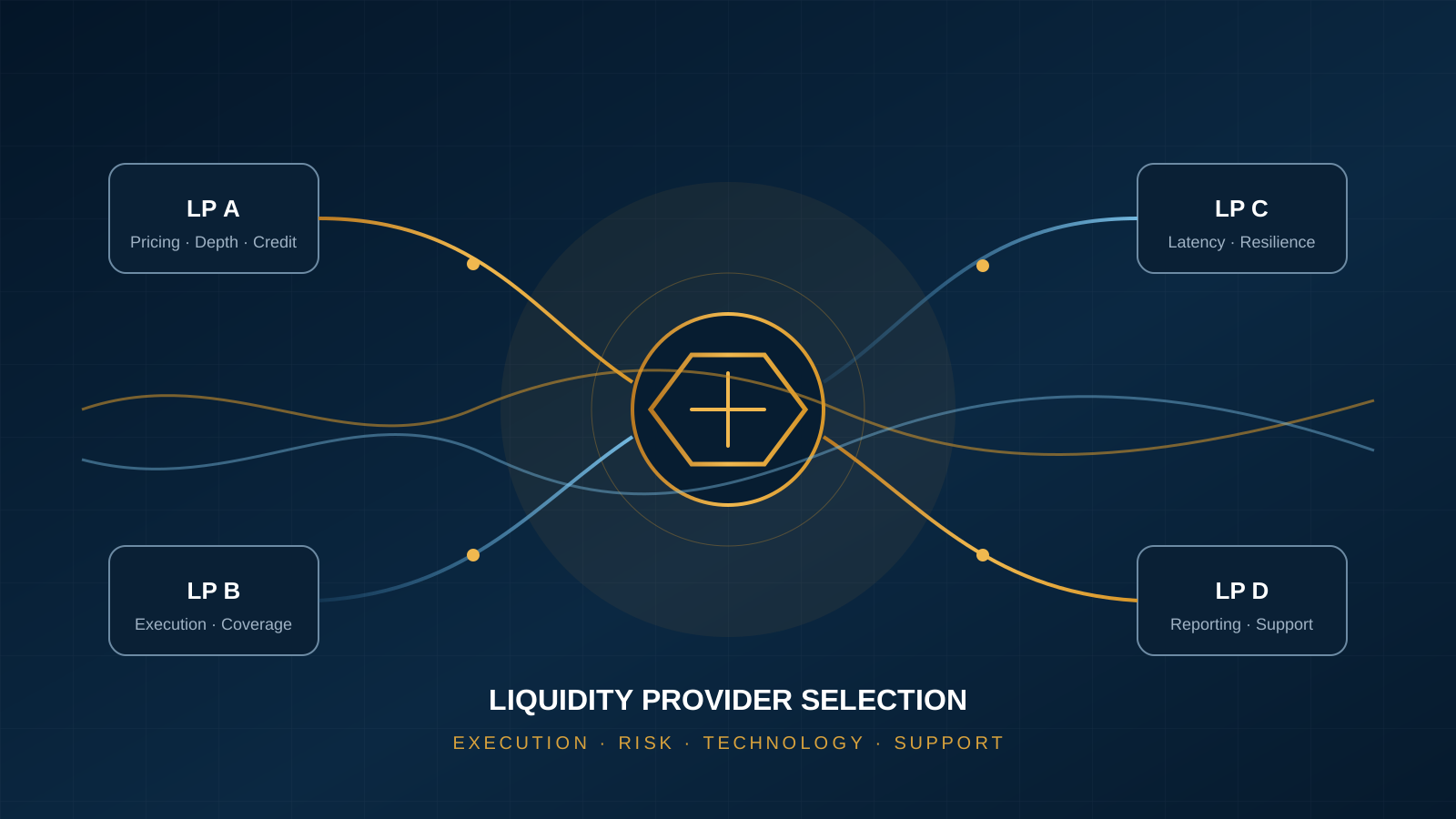
Choosing a liquidity provider is one of the most important infrastructure decisions a forex or CFD brokerage will make. The wrong provider can create recurring slippage, rejected orders, unstable pricing, margin pressure and difficult client conversations. The right provider can improve execution consistency, strengthen risk management and support the brokerage as its volumes, instruments and client base grow.
There is no universally “best” liquidity provider. The correct choice depends on the brokerage’s business model, jurisdictions, trading volumes, technology stack, client profile and approach to risk. The objective is therefore not to find the provider advertising the tightest spread. It is to identify the provider—or combination of providers—that delivers the most reliable all-in execution outcome for the brokerage.
Quick answer
What should a broker look for in a liquidity provider?
A forex or CFD broker should evaluate an LP across regulation, counterparty strength, product coverage, pricing depth, fill quality, last-look practices, technology, reporting, commercial terms and operational support. The provider should be selected only after live execution testing against realistic order flow.
1. Define the brokerage’s liquidity requirements first
A broker should not approach providers without first understanding its own operating requirements. A newly launched retail brokerage with modest volumes needs a different liquidity setup from an established broker processing institutional-size orders. An agency broker may also assess providers differently from a firm operating a hybrid A-book and B-book model.
Before requesting proposals, document the instruments to be offered, expected monthly volume, average and maximum ticket size, client locations, trading hours, required leverage, margin structure, expected externalised flow, platform and bridge technology, reporting requirements and the intended execution model.
The brokerage should also understand the likely characteristics of its client flow. Providers may respond differently to manual retail trading, high-frequency activity, news trading, copy trading or systematic order flow. This is not about automatically labelling strategies as “good” or “bad”; it is about determining whether the provider’s pricing model and risk appetite are compatible with the business the broker expects to send.
2. Verify the exact legal entity and regulatory status
A recognisable group name is not enough. The brokerage must identify the precise legal entity that will sign the agreement, hold margin, provide pricing and face the brokerage as counterparty.
Regulatory checks should establish the provider’s full legal name, registration number, regulator, licence status, permitted activities, registered address, relevant subsidiaries and any historical enforcement matters. Official regulator registers should be used rather than relying on marketing material or screenshots supplied by the provider.
Regulation does not remove counterparty risk, but it gives the brokerage a clearer framework for assessing governance, permissions and accountability. The legal review should also confirm whether the contracting entity is permitted to provide the relevant service and hold the type of funds or collateral contemplated by the agreement.
3. Understand where the liquidity actually comes from
The term “liquidity provider” covers several operating models. A provider may stream its own prices, aggregate prices from other counterparties, act as a prime-of-prime, operate as a non-bank market maker or combine several models.
The broker should understand whether the provider acts as principal or agent, whether pricing is internal or aggregated, how orders are routed, whether different instruments use different liquidity pools, whether any flow is internalised and how conflicts of interest are managed.
The Global Foreign Exchange Committee’s Liquidity Provider Disclosure Cover Sheet is a useful starting point for comparing providers’ disclosures and operating models. It does not replace bilateral due diligence, but it gives brokers a more consistent framework for asking the right questions.
4. Measure execution quality—not only quoted spreads
The narrowest displayed spread does not necessarily produce the lowest execution cost. A quote is valuable only if the provider can execute against it at the requested price and size. An LP displaying extremely competitive prices but generating frequent rejections, negative slippage or partial fills can produce a worse client outcome than a provider with a slightly wider but more executable price.
Execution testing should measure fill ratio, rejection ratio, positive and negative slippage, response time, partial-fill frequency, price improvement, performance by instrument, performance by ticket size, spread stability, market depth and results during different trading sessions.
These measurements should be segmented. A blended monthly average can hide weak execution in particular symbols, volume bands or market conditions. One LP may perform well in EUR/USD during London hours but offer weaker depth in metals or indices. Another may execute small orders consistently while struggling with larger tickets.
5. Understand last look and rejection practices
Last look is an electronic-trading practice under which a provider has a final opportunity to accept or reject a trade request made against its quoted price. Its existence is not automatically a reason to reject a provider. The key questions are how it is applied, why orders are rejected and whether the process is transparent and predictable.
A broker should ask what checks are performed, what can trigger a rejection, whether price improvement is possible, whether reject reasons are available, how stale pricing is identified and whether performance can be evaluated by symbol and order type.
Vague answers should be treated cautiously. An LP that cannot clearly explain its order-handling process makes it difficult for the brokerage to understand execution outcomes or investigate client complaints.
6. Test performance during difficult markets
Liquidity should not be assessed only during calm conditions. Economic data releases, central-bank decisions, market openings, geopolitical events and sudden gaps reveal far more about depth, spread stability, rejection handling and system capacity.
Before committing meaningful flow, run a controlled live pilot using expected instruments, order sizes, trading hours, execution types and client-flow profiles. The pilot should last long enough to capture more than one market regime. Demo execution alone is insufficient because demo pricing and execution may not reproduce the conditions applied to a live account.
7. Review technology and connectivity
A strong commercial proposition can still fail if the technical integration is unstable. The provider should be assessed against the brokerage’s platform, bridge, aggregator, hosting location and operational architecture.
Technical due diligence should cover FIX or platform connectivity, supported bridge technologies, data-centre locations, latency, backup sessions, recovery procedures, sequence handling, symbol mapping, contract specifications, quote precision, reject codes, timestamp quality, drop-copy availability, reporting APIs, scheduled maintenance and disaster recovery.
The brokerage should also establish responsibility across the LP, bridge provider, platform administrator and hosting provider. A formal escalation matrix should identify contacts, response expectations and ownership before production launch.
8. Assess counterparty, credit and settlement risk
The LP relationship may expose the brokerage to credit, operational, liquidity and settlement risks. Depending on the arrangement, the broker may place margin with the provider, settle realised profit and loss, meet intraday calls or maintain specific collateral levels.
Review initial and maintenance margin, credit limits, margin-call procedures, collateral location, segregation arrangements, netting rights, close-out provisions, withdrawal procedures, counterparty concentration and default procedures.
Where deliverable FX settlement is relevant, the settlement method also requires scrutiny. Payment-versus-payment arrangements can reduce principal risk because one currency is transferred only if the corresponding currency transfer occurs. The relevance of these risks will vary for rolling spot, CFDs and other derivative structures, so the specific legal and regulatory model should be reviewed independently.
9. Compare the complete commercial package
Headline spreads are only one part of the cost. The comparison should include commission, minimum volume, connectivity fees, bridge fees, market-data charges, financing and swap terms, margin requirements, deposit requirements, inactivity charges, withdrawal fees, minimum contract terms and termination rights.
The broker should calculate the expected all-in cost using realistic trading volumes and order sizes. A cheaper provider can become more expensive once poor execution, financing costs, operational interruptions or restrictive margin terms are considered.
10. Evaluate operational support
Liquidity relationships require continuous management. The broker should establish whether the provider offers 24/5 dealing support, technical support, emergency escalation, trade-investigation assistance, regular performance reviews, reconciliation support, advance notice of symbol changes and clear incident reporting.
Responsiveness should be tested before onboarding. Slow answers during the sales process are unlikely to improve after the agreement is signed.
Use a weighted scorecard
A documented scorecard prevents the decision from being dominated by one attractive feature. The weighting should reflect the broker’s model and risk appetite, but the same evidence and testing definitions should be applied to every shortlisted provider.
| Assessment area | Suggested weighting |
|---|---|
| Execution quality | 30% |
| Counterparty and regulatory assessment | 15% |
| Pricing and commercial terms | 15% |
| Reliability and resilience | 15% |
| Technology and connectivity | 10% |
| Operational support | 10% |
| Legal and contractual flexibility | 5% |
Common warning signs
- The provider refuses to identify the contracting entity.
- It cannot explain where pricing comes from or how orders are handled.
- It provides headline spreads but no execution-quality data.
- It cannot provide detailed trade reports or reject reasons.
- Margin, close-out or withdrawal terms are unclear.
- There is no backup connectivity or incident escalation process.
- The provider pressures the broker to commit before live testing.
Should a broker use more than one liquidity provider?
In many cases, yes—but simply adding LPs does not automatically improve liquidity. A multi-provider setup can support redundancy, pricing competition and broader product coverage, while also creating additional reconciliation, margin, aggregation and relationship-management complexity.
The objective should be to build a complementary pool in which each provider has a clear role. One provider may be stronger in major FX pairs, another in metals and another in larger ticket sizes. Their combined performance should be tested at the aggregated level rather than assumed.
Final checklist
- Who is the exact contracting entity?
- Is it appropriately authorised for the relevant activity?
- What is the execution model and where does liquidity come from?
- How are orders routed, checked and rejected?
- What are the live fill, rejection and slippage results?
- How does execution change during volatility?
- Is connectivity resilient and reporting sufficient?
- What margin, settlement and concentration risks arise?
- What is the total commercial cost?
- Who supports the relationship when something goes wrong?
LP monitoring should sit within the broker’s wider daily brokerage operations checklist, alongside platform, exposure, reconciliation, payment and incident controls.
Liquidity monitoring is only one part of the control environment. See the operational risks brokers often overlook for how execution, reconciliations, access and escalation connect.
Conclusion
Selecting a liquidity provider should be treated as an ongoing governance process rather than a one-time vendor decision. The strongest provider is not necessarily the one showing the narrowest price at a single point in time. It is the provider that delivers dependable execution, transparent order handling, suitable credit arrangements, resilient connectivity and responsive operational support across the conditions the brokerage is likely to face.
Execution quality, product coverage, commercial terms and service standards can change. Continuous monitoring and formal monthly or quarterly reviews help the broker identify deterioration early and adjust routing or provider allocation before it materially affects clients.
Frequently asked questions
Liquidity-provider selection FAQs
What is the most important factor when choosing a liquidity provider?
Execution quality is generally the most important operational factor, but it must be considered together with counterparty strength, regulation, technology and commercial terms. Tight pricing has limited value when orders are frequently rejected or negatively slipped.
Is the liquidity provider with the tightest spread always best?
No. Brokers should measure the effective executed cost, including commission, slippage, rejections, partial fills, financing and operational reliability.
How should a broker test a liquidity provider?
Use a controlled live pilot that reflects expected instruments, ticket sizes, trading sessions and client-flow characteristics. Compare providers using identical definitions and segmented execution reports.
Should a forex broker connect to multiple liquidity providers?
Multiple providers can improve resilience and competition when they are complementary and properly managed. More connections also increase technology, margin and reconciliation complexity.
What documents should be requested from an LP?
Request corporate and regulatory documents, financial information where appropriate, execution and order-handling disclosures, legal agreements, fee schedules, technical specifications and relevant FX Global Code materials.
How often should liquidity providers be reviewed?
Execution should be monitored continuously, supported by formal monthly or quarterly reviews. Material changes to the provider’s operating model, disclosures or contractual terms should trigger an additional review.
Prop firms allocating live capital or hedging trader exposure should also define how liquidity decisions connect to portfolio limits and operations. Read our prop firm risk and operations guide.
Reviewing your liquidity setup?
Build a more resilient LP and bridge framework.
Spot Liquidity helps forex and CFD brokers assess liquidity providers, execution performance, bridge configurations and operational infrastructure.
Book a ConsultationFurther reading
This article is provided for general informational purposes only and does not constitute financial, legal, regulatory or tax advice. Liquidity arrangements and regulatory requirements differ between jurisdictions and business models. Independent professional advice should be obtained before entering into any provider agreement.