
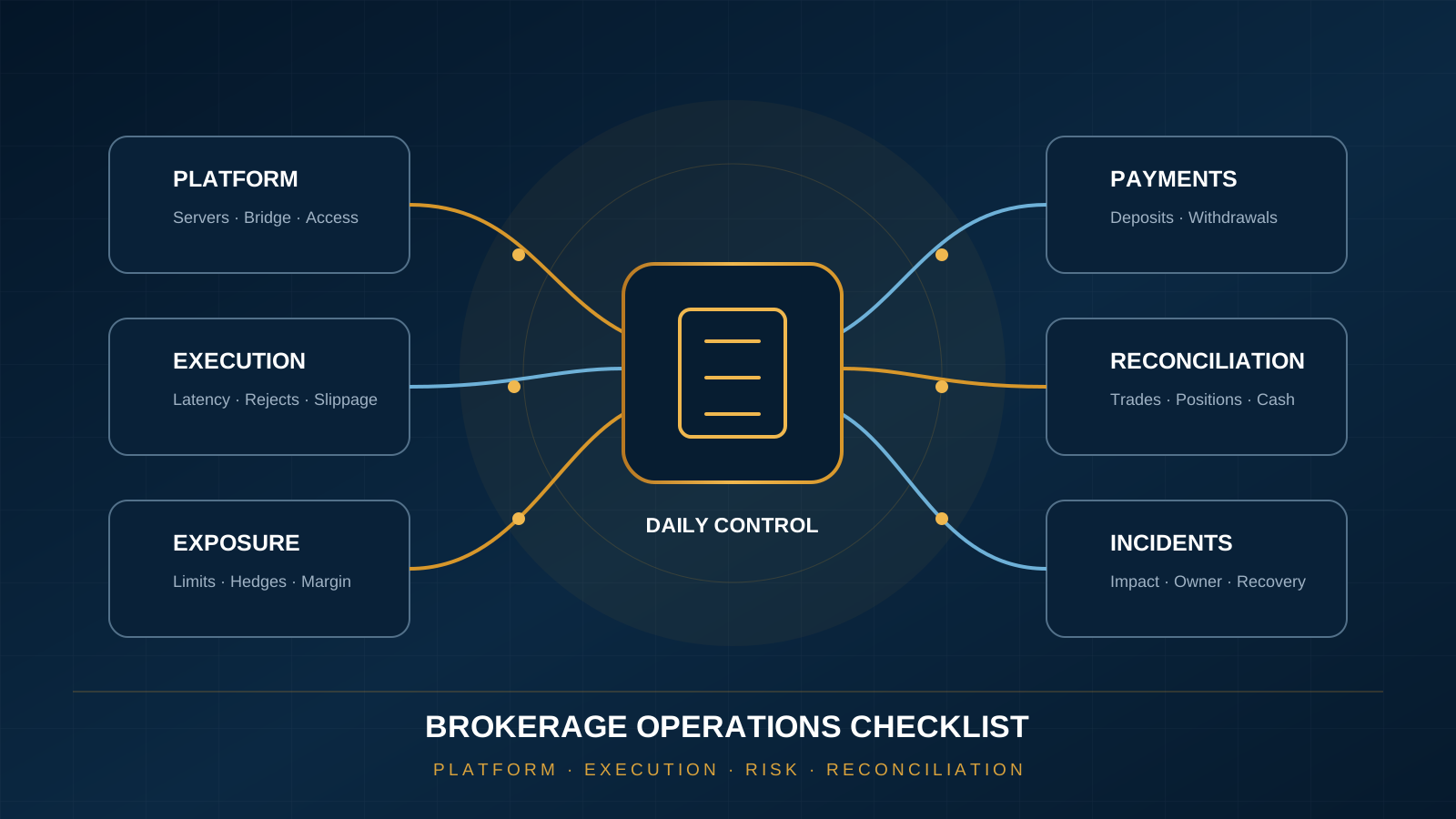
Daily brokerage operations are not limited to keeping the trading platform online. A forex or CFD broker must coordinate platform administration, price feeds, liquidity connections, risk, client money movements, reconciliations, access controls and incident management as one operating system. When these controls are handled in isolation, small exceptions can develop into execution disputes, incorrect balances, unmanaged exposure or extended service disruption.
The purpose of a daily brokerage operations checklist is to make critical controls visible, assign clear ownership and create evidence that exceptions were identified and resolved. The checklist should be proportionate to the brokerage’s size, regulatory obligations, execution model and technology stack. It is not a substitute for formal policies, regulatory advice or specialist risk oversight.
Quick answer
What should a forex or CFD broker monitor every day?
A broker should monitor platform and bridge availability, price-feed health, symbol and margin settings, market exposure, execution quality, client margin, payments, trade and cash reconciliations, support cases, privileged access, incidents and unresolved exceptions. Every control should have an owner, evidence of completion and a defined escalation threshold.
Why a daily brokerage operations checklist matters
Brokerage infrastructure is highly interconnected. A symbol-session error can stop clients from trading. A stale price feed can create invalid executions. A missed LP reconciliation can conceal a position mismatch. A payment adjustment entered without independent review can affect client balances. The immediate symptom may appear in one system even though the root cause sits elsewhere.
A structured checklist reduces dependence on individual memory and creates a repeatable operating rhythm. It also helps management distinguish a genuine control from an informal task. A control is not complete merely because someone looked at a dashboard; the expected outcome, supporting evidence, tolerance and escalation path should be defined in advance.
The principles are consistent with broader operational-resilience practices: identify critical operations, understand technology and third-party dependencies, maintain response plans and learn from incidents. The exact control design must still reflect the broker’s own legal entities, licences, jurisdictions and business model.
The 15 daily brokerage operations controls
1. Confirm platform, server and bridge availability
Start with the infrastructure through which clients view prices and place orders. Confirm that trading servers, access servers, manager connections, web and mobile access, bridges, gateways and relevant APIs are available. Review connection failures, unusual resource utilisation, delayed processes and overnight restarts.
The test should cover the client journey rather than relying only on a server-status indicator. A service may technically be online while authentication, quote delivery or order routing is impaired. Record any degraded service and confirm whether redundancy or failover arrangements operated as expected.
2. Validate price feeds and symbol availability
Check that expected symbols are quoting, timestamps are current and bid–ask behaviour is consistent with the underlying market. Look for frozen quotes, crossed prices, abnormal gaps, missing depth, duplicate feeds or one source materially diverging from others.
Controls should also verify market sessions and instrument status. Products that should be closed must not remain tradable, while instruments expected to be open should not be disabled by an incorrect holiday file or session schedule.
3. Review high-risk trading settings
Platform settings directly affect client pricing and risk. Review recent or scheduled changes to spreads, mark-ups, commissions, swaps, leverage, margin rates, stop levels, contract sizes, execution modes and client-group assignments. Give additional attention to newly launched symbols and any configuration copied across groups.
High-impact changes should be independently checked before release. Where the platform supports change logs or journals, retain them with the approval record. A broker should be able to establish who changed a setting, when it changed, why it changed and who verified it.
4. Prepare for market events, holidays and contract changes
Review the economic calendar, exchange holidays, early closes, daylight-saving changes, futures expiries, corporate actions and expected liquidity events. Determine whether trading hours, margin requirements, maximum order sizes or internal risk limits need temporary adjustment.
The objective is not to predict market direction. It is to ensure the operating environment is prepared for conditions that may produce wider spreads, reduced depth, delayed fills or sharp exposure changes. Any temporary restrictions should be approved, documented and communicated through the appropriate client channels.
5. Monitor net exposure and concentration
Track net exposure by symbol, asset class, currency, client group and legal entity. Compare live positions against approved risk limits and available liquidity or hedging capacity. A total exposure number can hide concentrations, so the review should identify the instruments and accounts driving the position.
For hybrid models, compare internalised and externalised flow and verify that hedging logic is operating as intended. Investigate sudden changes in A-book or B-book allocation, unexpected residual positions and hedge orders that did not reach the intended venue.
6. Monitor execution quality
Review fill rates, rejection rates, execution latency, positive and negative slippage, partial fills, requotes where applicable and orders completed outside expected tolerances. Segment results by liquidity provider, symbol, session, order type and ticket size; averages alone can hide a problem concentrated in one product or route.
Execution monitoring should use consistent definitions. A broker comparing providers should know exactly how latency, slippage and rejects are calculated. For a deeper selection framework, see How to Choose a Liquidity Provider for Your Forex or CFD Brokerage?.
7. Investigate pricing and execution anomalies
Create alerts for outlier trades, off-market prices, unusually wide or narrow spreads, repeated reject reasons, order bursts and executions during suspected feed interruptions. The aim is to identify both technology failures and activity requiring a legitimate trade review.
Do not resolve an anomaly by deleting or adjusting a trade without evidence. Preserve platform, bridge and liquidity-provider logs, establish the relevant timestamps and document the rationale for any correction. Client-impacting decisions should follow the broker’s terms, policies and applicable legal requirements.
8. Review client margin, equity and stop-out events
Monitor accounts approaching margin-call or stop-out thresholds, large negative equity movements and concentrations of highly leveraged positions. Confirm that margin calculations and stop-out logic are behaving consistently with the configured rules.
Where market gaps or operational incidents create negative balances, route cases through the broker’s approved treatment process. Manual credits, balance corrections and goodwill adjustments should not be used as an informal substitute for root-cause analysis.
9. Escalate unusual client trading patterns
Operations and dealing teams are often the first to observe activity that differs materially from the expected flow. Examples may include repeated order bursts, coordinated accounts, latency-sensitive patterns, account sharing indicators or trading concentrated around pricing interruptions.
Unusual does not automatically mean abusive. Escalation should be evidence-led and follow documented procedures involving the appropriate risk, compliance or legal functions. Avoid subjective labels in operational notes; record the observable behaviour, affected orders, timestamps and systems.
10. Control deposits, withdrawals and balance adjustments
Review pending and failed deposits, withdrawal queues, chargebacks, reversals, payment-provider outages and unmatched transactions. Client balance adjustments, credits and transfers should be supported by evidence and subject to maker–checker approval according to the broker’s authority matrix.
Prioritise exceptions that could cause a client’s trading account to differ from the broker’s payment or ledger records. A daily ageing view should show how long each unresolved item has remained open and who owns the next action.
11. Reconcile trades, positions, balances and cash
Reconcile the trading platform against the bridge or gateway, liquidity-provider statements, CRM or back-office system, payment records and the broker’s accounting or treasury records as relevant. Core checks include position quantities, opening prices, realised and unrealised P&L, swaps, commissions, deposits, withdrawals and client balances.
Differences should be classified rather than carried forward as a single unexplained total. Common categories include timing differences, rejected hedges, symbol mapping, rounding, duplicate postings, manual adjustments and missing transactions. Material breaks require immediate escalation and should remain visible until resolved.
12. Review trade disputes and critical support cases
Identify open cases involving missing orders, disputed prices, delayed withdrawals, platform access, incorrect swaps or suspected configuration errors. Link each case to the supporting logs and assign a service deadline appropriate to its severity.
Repeated tickets on the same issue are an operational signal. Management reporting should distinguish isolated client queries from incidents affecting multiple accounts, products or systems.
13. Review privileged access and sensitive changes
Check new, removed and amended administrator, manager, dealing, payment and database access. Confirm that leavers and transferred staff no longer retain inappropriate permissions and that shared or dormant privileged accounts are investigated.
Review sensitive actions such as balance amendments, trade corrections, group changes, symbol changes and risk-limit overrides. Access should follow least-privilege principles, while critical changes should require independent approval and leave a reliable audit trail.
14. Maintain an active incident and vendor-dependency view
Record active incidents across trading platforms, hosting, bridges, liquidity providers, market-data vendors, CRM, payment providers and communications services. For each incident, capture impact, start time, affected clients or systems, owner, workaround, vendor reference and next update.
Third-party status updates are not enough on their own. The broker should assess its own client and risk impact, decide whether contingency arrangements are required and document lessons after recovery. Repeated failures should feed into vendor reviews and resilience planning.
15. Close the day with an exception report
Produce a concise end-of-day report covering critical metrics, completed controls, limit breaches, unresolved reconciliations, client-impacting cases, incidents, manual adjustments and actions due on the next operating day. The report should highlight exceptions rather than overwhelm management with raw system data.
An item is not closed because it has been mentioned in an email. Assign an owner and target date, preserve evidence and carry unresolved items forward until independently confirmed as resolved.
Daily control matrix
The following matrix can be adapted to the broker’s operating model. Thresholds should be approved internally rather than copied from another firm.
| Control area | Typical owner | Minimum frequency | Example escalation trigger |
|---|---|---|---|
| Platform and bridge availability | Technology / Operations | Start of day and continuous alerts | Client access, quoting or routing is unavailable or degraded |
| Price feeds and symbol status | Dealing / Platform | Start of day and continuous alerts | Stale, crossed, missing or materially divergent prices |
| Trading configuration | Platform Administration | Daily change review | Unapproved or unexpected change to margin, swaps, spreads or groups |
| Exposure and limits | Risk / Dealing | Intraday | Limit breach, concentration or failed hedge |
| Execution quality | Dealing / Risk | Intraday and end of day | Rejects, latency or slippage outside approved tolerance |
| Payments and adjustments | Payments / Operations | Intraday and end of day | Unmatched payment, aged withdrawal or unapproved adjustment |
| Reconciliations | Operations / Finance | Daily | Material or unexplained trade, position, balance or cash break |
| Privileged access | Technology / Control Function | Daily change review | Unauthorised access, dormant privilege or unexplained sensitive action |
| Incidents and vendors | Operations / Technology | Continuous and end of day | Client impact, missed recovery target or recurring third-party failure |
How to implement the checklist without creating bureaucracy
The checklist should be detailed enough to control risk but short enough to be completed consistently. Begin with critical operations and the failures that could cause material client, financial, regulatory or reputational impact. Remove duplicate checks and automate evidence collection where reliable data is available.
- Assign one accountable owner: several teams may perform controls, but one person should coordinate completion and unresolved exceptions.
- Define tolerances: specify what normal looks like and the point at which an issue must be escalated.
- Preserve evidence: retain reports, screenshots, logs, approvals or system records appropriate to the control.
- Use maker–checker for high-impact actions: separate initiation and approval for sensitive configuration and balance changes.
- Track ageing: unresolved exceptions should show an owner, status, target date and business impact.
- Review the checklist after incidents: a recurring failure usually indicates that the control design, threshold or ownership needs improvement.
What should be automated?
Automation is most useful for repetitive data collection and objective exception detection: server-health alerts, stale-price checks, limit monitoring, reconciliation matching, ageing reports and access-change reports. Human review remains important where context, client impact or judgement is required.
A weak manual process does not become a strong control merely because it is placed in a dashboard. Automated alerts need tested data sources, clear thresholds, ownership and escalation. False positives that are routinely ignored can be as dangerous as having no alert.
Warning signs that the operating process is failing
- Daily checks depend on one person’s memory or personal spreadsheet.
- Teams use different position, P&L or exposure numbers without reconciliation.
- Exceptions are discussed in chat but are not assigned or tracked.
- Manual balance or trade adjustments can be completed without independent approval.
- LP, bridge and platform timestamps cannot be aligned during an investigation.
- Repeated client complaints are treated individually rather than analysed as a common issue.
- Vendor incidents are closed when the vendor recovers, without assessing internal impact.
- Management receives large reports but no clear view of breaches and unresolved items.
Online funded-trader businesses face many of the same platform and operational dependencies, but require additional controls around trader rules, payouts and strategy concentration. See Why Prop Firms Need Risk Management and Operational Expertise.
For a broader view of how small control gaps can turn into financial, execution and client risk, read When Brokerage Operations Fall Short: The Risks Brokers Often Overlook.
Conclusion
A reliable brokerage operations function is built around visible controls, clear ownership and disciplined exception management. The objective is not to create a longer checklist. It is to identify the controls that protect trading, client balances, market exposure and operational continuity—and to ensure that failures are escalated before they become larger incidents.
The framework should evolve as the broker adds jurisdictions, platforms, liquidity providers, products and payment channels. A periodic review of controls, thresholds and evidence helps ensure the process remains proportionate to the brokerage’s actual risk rather than the operating model it had at launch.
Frequently asked questions
Daily brokerage operations FAQs
What should a forex broker monitor every day?
A forex broker should monitor platform and bridge availability, price feeds, symbol settings, market exposure, execution quality, client margin, payments, reconciliations, privileged access, incidents and unresolved exceptions every trading day.
Who should own the daily brokerage operations checklist?
A named operations owner should coordinate completion. Dealing, risk, payments, finance, technology and compliance teams should remain accountable for controls within their respective functions.
How often should a brokerage reconcile trades and balances?
Critical trade, position, cash and client-balance reconciliations should be performed at least daily. Higher-frequency or intraday checks may be appropriate depending on volumes, risk limits, payment activity and the brokerage’s operating model.
Which brokerage controls should use maker–checker approval?
High-impact changes typically include client balance adjustments, trade corrections, payment releases, leverage or margin changes, symbol configuration and privileged-access changes. The precise approval framework should reflect internal authority limits and applicable regulation.
Can a broker automate the entire operations checklist?
No. Monitoring and reconciliation matching can be heavily automated, but exceptions, client-impact decisions, trade disputes and high-risk changes still require accountable human review.
Is this checklist the same for every brokerage?
No. It should be adapted to the broker’s jurisdictions, licences, products, execution model, technology, liquidity arrangements, client profile and regulatory obligations.
Strengthening your operating controls?
Build a more disciplined brokerage operations framework.
Spot Liquidity supports forex and CFD brokers with platform administration, liquidity and bridge oversight, operational controls, reconciliations and scalable day-to-day processes.
Book a ConsultationFurther reading
This article is provided for general informational purposes only and does not constitute financial, legal, regulatory or tax advice. Operational controls and regulatory requirements differ between jurisdictions, licences and business models. Independent professional advice should be obtained when designing or changing a brokerage control framework.