
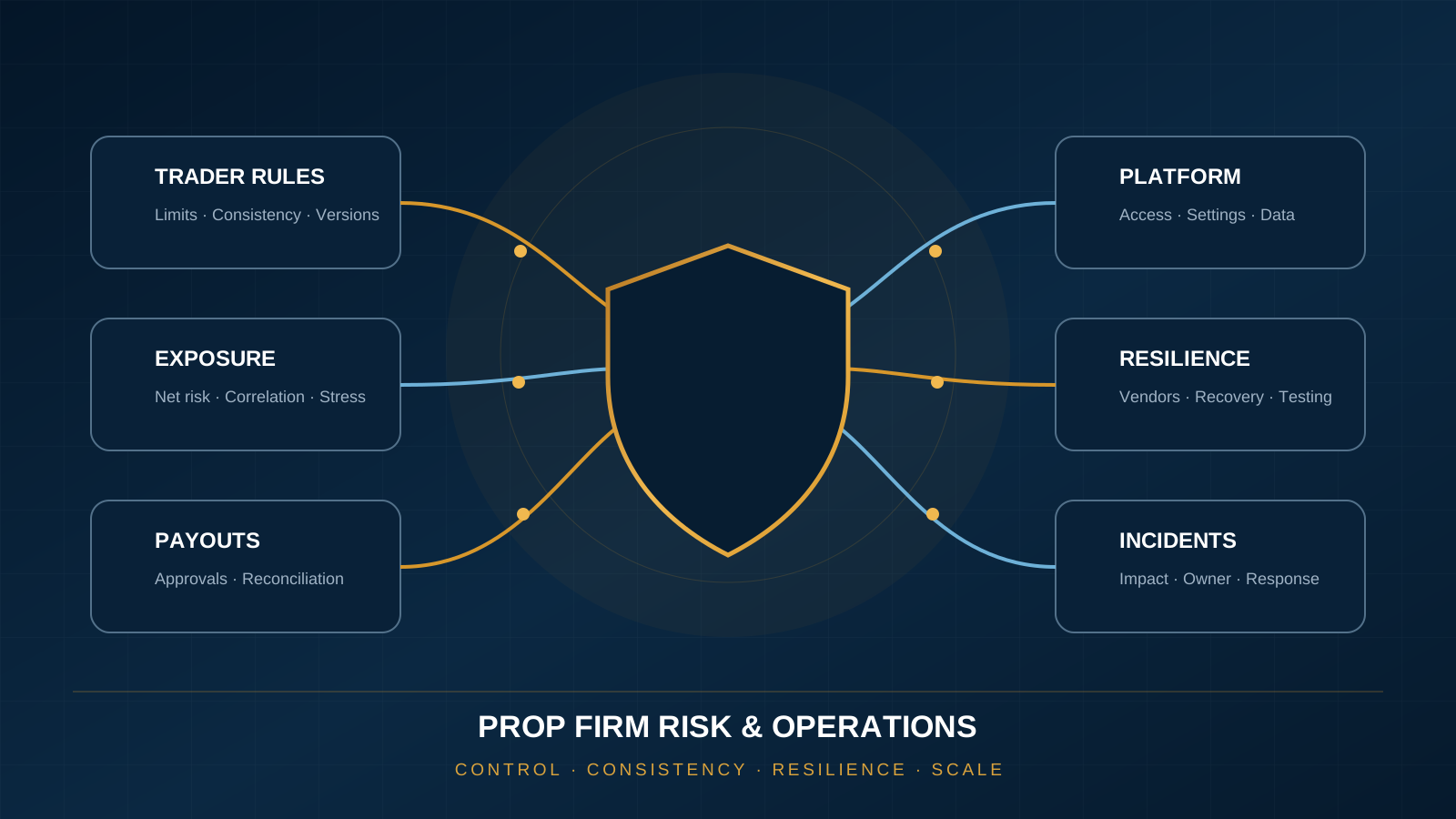
For an online prop trading firm, growth can expose weaknesses faster than it creates stability. More traders mean more strategy concentration, more rule evaluations, more platform activity, more payouts, more support cases and a greater dependency on technology vendors. Without a joined-up risk and operations framework, the firm can look successful at the front end while financial and operational exceptions build underneath.
The term prop firm can describe different models. Traditional proprietary trading firms deploy their own capital through employed or contracted traders. Online funded-trader businesses commonly sell evaluations, operate simulated trading environments and may allocate selected traders to live capital. The controls required depend on the model, jurisdictions, products and legal structure. This article focuses on the operational and risk-management principles relevant to online prop firms and funded-trader programmes.
Quick answer
Why do prop firms need risk management and operational expertise?
Prop firms need risk management to control drawdown, exposure, strategy concentration, rule breaches and capital at risk. They need operational expertise to ensure those controls are applied consistently across trading platforms, account creation, data, payouts, support, vendors and incidents. One without the other creates gaps: risk rules may exist but fail operationally, or smooth workflows may scale activity without controlling the underlying exposure.
What does prop firm risk management actually cover?
Prop firm risk management is broader than setting a maximum daily loss. It is the operating framework that determines how much risk the firm accepts, how trader activity is measured, when exposure is reduced or hedged, who can change critical settings and how exceptions are investigated.
A robust framework should connect four layers:
- Trader-level controls: daily loss, maximum drawdown, position size, instrument restrictions, news rules, overnight exposure and strategy consistency.
- Portfolio-level controls: gross and net exposure, correlated positions, concentration by symbol or strategy, gap risk and liquidity requirements.
- Operational controls: platform configuration, account permissions, rule-engine accuracy, payout reviews, reconciliations and incident handling.
- Governance: approved risk appetite, documented thresholds, independent review, management reporting and clear authority for exceptions.
Broader risk-management standards used by regulated derivatives firms commonly emphasise written limits, intraday monitoring, stress testing, documented exceptions and management oversight. Those requirements may not apply directly to every prop firm, but the control logic is highly relevant to any business carrying trading, technology or payout risk.
Why trading rules alone are not enough
A rule has no value if the platform applies it incorrectly, the data arrives late or the operations team cannot explain the outcome. For example, a maximum-loss rule may use balance rather than equity, reset at the wrong timezone, treat commissions inconsistently or behave differently after a platform migration. The published terms may be clear while the actual calculation is not.
Operational expertise converts policies into repeatable processes. It defines how accounts are created, which template is applied, how rules are version-controlled, what evidence is retained, who reviews a breach and how the trader is informed. It also connects the trader-facing environment to finance, technology, risk and management reporting.
Eleven controls that support smooth prop firm operations
1. Define the risk appetite and unit economics
The firm should know the maximum loss it is prepared to absorb by trader, strategy, instrument, day and portfolio. That limit must be consistent with available capital, expected evaluation revenue, payout obligations, hedging costs and operating expenses.
Challenge fees should not be treated as a substitute for risk discipline. Management needs a clear view of how revenue, pass rates, payout ratios, live allocation and market exposure interact under normal and stressed conditions. A business can generate strong sales while its payout or hedging assumptions are deteriorating.
2. Turn trader rules into controlled system logic
Every published rule should map to a precise system calculation. Define the data source, timezone, reset point, treatment of commissions and swaps, open-position valuation, breach timestamp and appeal process. The same rule should produce the same result across the website, CRM, trading platform and internal review tools.
Changes require version control. New and existing accounts may need different rule sets, and the firm should be able to prove which version applied to a specific trader on a specific date. High-impact changes should use maker–checker approval and pre-production testing.
3. Monitor exposure and concentration in real time
Trader-level drawdown does not show the firm’s total market risk. Multiple traders may hold the same directional position, use correlated instruments or enter similar strategies around the same event. Monitor gross and net exposure by symbol, asset class, currency, trader cohort and strategy.
Concentration controls should identify whether apparently diversified accounts are creating one economic exposure. EUR/USD long positions, short US dollar index positions and long gold positions may behave differently in normal markets but become highly correlated during a sharp dollar move. Thresholds should account for correlation, liquidity and gap risk rather than position count alone.
4. Separate trading skill from rule circumvention and platform abuse
Prop firms need a consistent method for reviewing latency-sensitive activity, cross-account coordination, account sharing, copy trading, prohibited automation, pricing anomalies and strategies designed around weaknesses in the evaluation environment. The review should focus on observable evidence rather than subjective labels.
Automated alerts can identify unusual patterns, but final decisions should consider platform logs, timestamps, pricing sources, account relationships and the published terms. Vague or retrospective enforcement creates disputes and reputational damage. The firm should explain what behaviour is restricted and apply the same review standard across comparable cases.
5. Protect price, execution and data integrity
Evaluation and funded accounts depend on accurate quotes, timestamps, contract specifications and trading sessions. A stale feed, incorrect symbol mapping or inconsistent spread can create false rule breaches, invalid profits or widespread complaints.
Daily controls should identify frozen prices, abnormal gaps, crossed quotes, delayed data, incorrect sessions and material differences between environments. Where live exposure is routed externally, the firm should also monitor execution latency, rejection rates, slippage and residual positions. A platform status marked “online” does not prove that the end-to-end trading journey is healthy.
6. Establish a controlled live-capital and hedging framework
Not every successful trader should be handled in the same way. The decision to keep activity simulated, allocate live capital, copy selected strategies or hedge aggregate exposure should follow approved criteria. These may include track record, drawdown behaviour, strategy capacity, holding period, liquidity, correlation and operational complexity.
Where hedging is used, define the trigger, route, order sizing, tolerance and reconciliation process. Uncontrolled copying can create execution mismatch, slippage and concentration. A hybrid framework should be transparent internally even where the commercial model is not disclosed publicly.
7. Control payouts and financial reconciliations
Payouts are both a financial obligation and a core trust point. The process should reconcile eligible profits, rule status, previous withdrawals, fees, adjustments and payment details before release. Sensitive changes to beneficiary information or account balances should require independent approval.
Finance and operations should reconcile challenge revenue, refunds, chargebacks, platform balances, approved payouts and actual payment movements. A growing backlog, repeated manual adjustments or differences between CRM and finance records are signs that the operating model is not scaling safely.
8. Govern platform access and critical changes
Administrator and manager access can change accounts, rules, balances, symbols and trade records. Apply role-based permissions, multi-factor authentication where supported, periodic access reviews and immediate removal when responsibilities change.
Critical settings should not be changed through informal messages. Use a documented request, approval, testing and implementation process with retained logs. Emergency access should be time-limited and reviewed after use.
9. Manage vendor dependency and operational resilience
Prop firms depend on trading platforms, CRMs, rule engines, data feeds, payment providers, hosting, identity tools and support systems. A failure at one provider can affect thousands of accounts even when the firm’s own team has done nothing wrong.
Map the services required to deliver critical operations, identify single points of failure and define recovery priorities. Due diligence should cover service availability, data ownership, access controls, backups, support escalation, change notifications and exit arrangements. The firm should test how it will continue or communicate if a critical provider is unavailable.
10. Build an incident and trader-communication process
When a pricing, platform or rule-engine issue occurs, the response should be coordinated. Define who declares the incident, freezes affected actions, preserves evidence, assesses trader impact and approves communications. Avoid making irreversible account decisions before the relevant logs and timestamps are secured.
Trader communications should state what is known, what is being investigated and when the next update will be provided. After recovery, complete a root-cause review and track corrective actions. Repeatedly resolving individual complaints without fixing the underlying control is not incident management.
11. Give management an exception-based operating view
Management does not need another large dashboard. It needs a reliable view of limit breaches, concentrated exposure, unusual trader activity, payout ageing, reconciliation breaks, platform incidents, vendor issues and unresolved complaints.
Reports should show the owner, business impact, current status and target resolution date. Trends matter: a stable headline number can conceal a rising number of manual overrides or repeated exceptions. The purpose of management information is to support decisions, not simply prove that data was produced.
How risk management and operations work together
| Area | Risk question | Operational control | Failure indicator |
|---|---|---|---|
| Trader rules | What loss and behaviour is permitted? | Rule mapping, testing, version control and evidence | Similar accounts receive different outcomes |
| Portfolio exposure | How much correlated risk can the firm absorb? | Live monitoring, limits, alerts and stress scenarios | Exposure is reviewed only after a market move |
| Platform | Can settings or data create unintended risk? | Access controls, change approval and health checks | Unexplained configuration or repeated feed issues |
| Live allocation | Which traders or strategies should reach capital? | Approved selection, routing and reconciliation process | Copying or hedging decisions are ad hoc |
| Payouts | Is the payment valid and affordable? | Eligibility review, maker–checker and finance reconciliation | Aged payouts, chargebacks or manual balance fixes |
| Vendors | How long can critical services be disrupted? | Dependency mapping, escalation, backups and testing | No tested recovery or exit route |
| Incidents | How will financial and trader impact be contained? | Incident owner, evidence, communications and root-cause review | Complaints are closed without correcting the cause |
Common prop firm operating mistakes
- Using strict trader limits without defining portfolio-level risk limits.
- Publishing rules that cannot be reproduced consistently in system data.
- Changing challenge conditions without version control or account segmentation.
- Relying on one administrator who holds undocumented platform knowledge.
- Reviewing suspicious activity through screenshots instead of complete logs.
- Approving payouts without reconciling CRM, platform and finance records.
- Assuming simulated trading removes operational, legal or reputational risk.
- Adding traders faster than support, finance and incident capacity can scale.
- Depending on vendors without tested escalation and recovery procedures.
- Tracking incidents in chat messages instead of a controlled exception log.
How to build the framework without slowing growth
Start with the failures that could create material capital loss, invalid trader outcomes, delayed payouts or widespread service disruption. Assign an accountable owner and define the threshold, evidence and escalation route for each control. Do not try to automate everything at once.
- Document the operating model: distinguish simulated activity, live allocation, copied strategies and external hedging.
- Map every published rule: connect the legal terms to an exact system calculation and review process.
- Create a daily risk view: exposure, concentration, rule breaches, payouts, incidents and unresolved exceptions.
- Protect critical actions: use role-based access and maker–checker approval for high-impact changes.
- Reconcile the full lifecycle: evaluation purchase, account creation, trading result, payout approval and payment.
- Test disruption scenarios: platform outage, stale pricing, rule-engine failure, payment delay and vendor unavailability.
Automation should collect data, calculate objective thresholds and route exceptions. Experienced staff should remain accountable for ambiguous breaches, trader-impact decisions, incident severity and changes to the risk framework.
How Spot Liquidity can support prop firms
Spot Liquidity supports prop trading businesses where platform administration, risk oversight and operations intersect. Engagements can focus on a specific weakness or on the design of a connected operating framework.
- Prop firm operating-model and control reviews
- Drawdown, exposure and concentration-monitoring frameworks
- Trading platform configuration, permissions and change governance
- Trader lifecycle, evaluation, payout and exception workflows
- Live-capital, copying and hedging process design
- Daily controls, reconciliations and management reporting
- Vendor dependency, incident response and operational-resilience planning
For a broader day-to-day control framework, see our Daily Brokerage Operations Checklist. Firms routing live market exposure should also review How to Choose a Liquidity Provider for Your Forex or CFD Brokerage?.
Conclusion
A prop firm’s rules define the promise, but operations determine whether that promise can be delivered consistently. Smooth operations require accurate platform logic, visible exposure, controlled payouts, reliable vendors, disciplined incident handling and management information that focuses on exceptions.
The uncomfortable truth is that rapid trader acquisition can magnify a weak operating model. Firms that build risk management and operational expertise early are better positioned to scale without relying on manual intervention, inconsistent decisions or emergency fixes.
Frequently asked questions
Prop firm risk management FAQs
What is prop firm risk management?
Prop firm risk management is the framework used to define trader limits, monitor drawdown and portfolio exposure, identify concentration or rule breaches, control platform changes, reconcile payouts and manage incidents before they create material loss.
Why do prop firms need operational expertise?
Operational expertise connects trading rules, platform settings, trader reviews, payouts, data, vendors and incident response. Without that coordination, a valid risk policy can be applied inconsistently or fail as volumes grow.
Should a prop firm hedge trader exposure?
It depends on whether trading is simulated or live, the firm’s capital model, strategy concentration, liquidity access and risk appetite. Any hedging framework should use defined thresholds, approved routes and reliable reconciliation.
What should a prop firm monitor every day?
A prop firm should monitor rule breaches, gross and net exposure, strategy concentration, platform and pricing health, live allocations, payout ageing, reconciliation breaks, privileged changes, vendor incidents and unresolved trader-impact cases.
Can prop firm risk management be fully automated?
No. Systems can automate calculations, alerts and data matching, but ambiguous trading behaviour, trader-impact decisions, incident severity and material exceptions require accountable human judgement.
Do prop firms need regulatory authorisation?
The answer depends on the legal structure, jurisdiction, marketing, products, trader relationship and whether the activities amount to regulated financial services. Firms should obtain jurisdiction-specific legal and regulatory advice before launch and when changing their model.
Building or scaling a prop firm?
Strengthen the controls behind your trader experience.
Spot Liquidity helps prop firms connect risk management, platform governance, trader operations, payouts and incident response into a more resilient operating model.
Book a ConsultationFurther reading
- Operational resilience principles — Basel Committee on Banking Supervision
- Third-party risk principles — Basel Committee on Banking Supervision
- Risk-based limits and monitoring principles — U.S. Commodity Futures Trading Commission
- MetaTrader 5 platform controls for brokers — MetaQuotes
- Contract for differences: regulatory expectations — UK Financial Conduct Authority
This article is provided for general informational purposes only and does not constitute financial, legal, regulatory or tax advice. Prop-firm structures, products and regulatory obligations differ by jurisdiction and business model. Independent professional advice should be obtained before launching or changing a prop trading programme, risk framework or live-capital arrangement.