
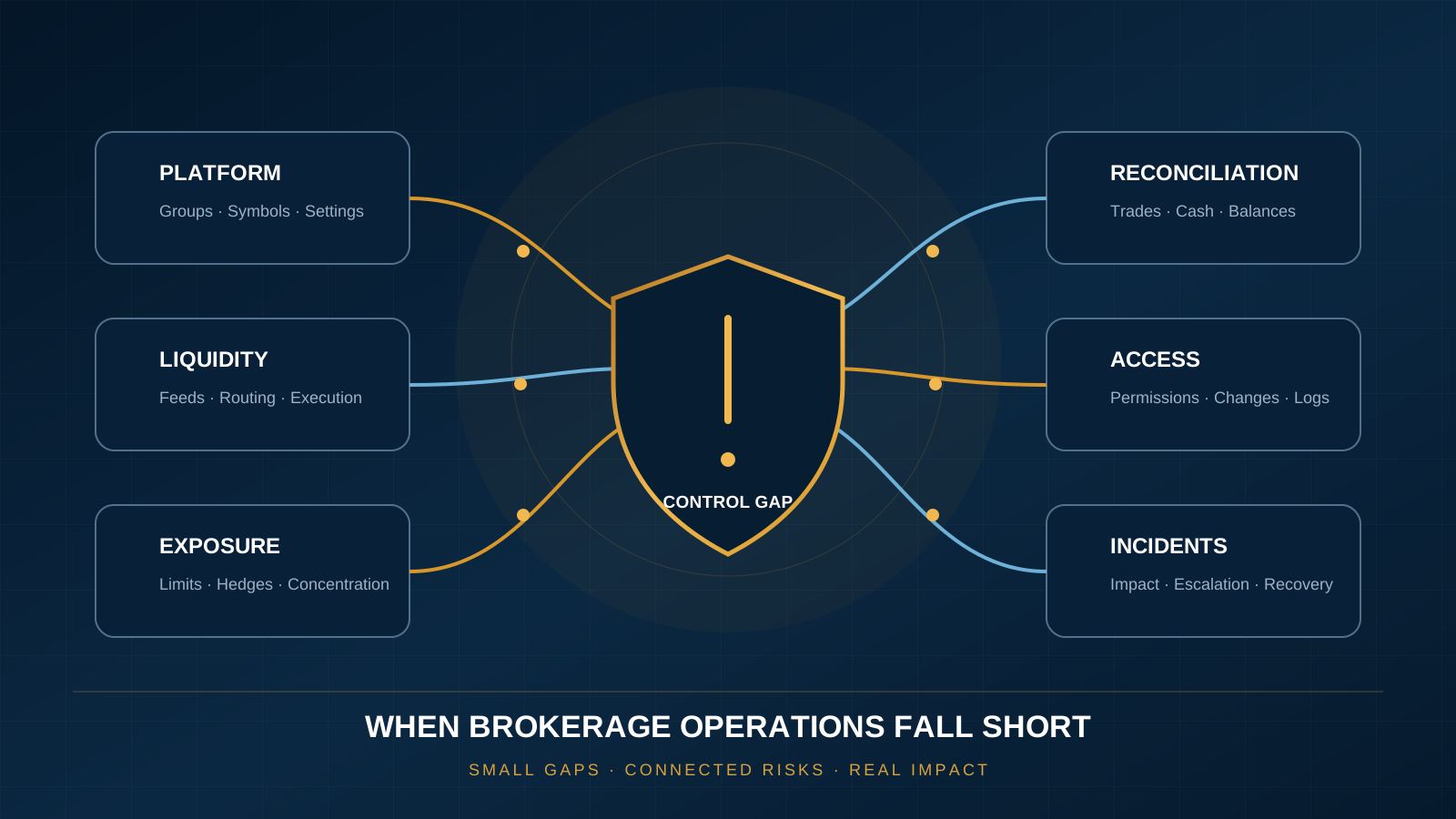
A brokerage can have a strong trading platform, reputable liquidity providers and growing client volumes—and still be operationally fragile. The weakness is often not visible in the technology itself. It sits between systems, teams and decisions: who checks a configuration change, who notices execution deteriorating, who reconciles a difference, who challenges an exposure, and who takes ownership when something does not look right.
That is why brokerage operations should not be treated as a purely administrative function. In a forex or CFD business, operations is part of the control layer around trading. It connects the platform, bridge, liquidity providers, dealing and risk teams, finance, payments, client support and management. When that layer is weak, relatively small errors can move quickly across the business.
Quick answer
What happens when brokerage operations fall short?
Weak brokerage operations can allow platform errors, execution problems, unmanaged exposure, reconciliation differences, incorrect financing charges, access issues and vendor incidents to remain undetected or unresolved. The immediate problem may appear small, but the financial and client impact can grow when there is no clear owner, independent check, escalation threshold or evidence trail.
Operations is not just “back office”
In a trading business, an operational decision can change a financial outcome. A symbol specification can determine contract size and margin. A group setting can change leverage or swap treatment. A bridge rule can influence where an order is routed. A delayed hedge can alter market exposure. A manual balance adjustment can change a client liability. A missed reconciliation can hide an unexplained difference for days.
Eight operational risks brokers often overlook
1. Platform configuration errors that look harmless
Trading platforms contain hundreds of settings across symbols, groups, permissions, sessions, leverage, margin, commissions, swaps and plugins. Many changes are routine, which can create false confidence. A single incorrect digit or an untested template can affect an entire client group.
Examples include the wrong contract size, an incorrect swap multiplier, a market session left open or closed at the wrong time, leverage applied to the wrong group, or a symbol mapped inconsistently between the platform and bridge. The error may not trigger an obvious system alert. It may first appear as unusual client P&L, a margin complaint or a reconciliation difference.
2. Execution deterioration that nobody measures
A liquidity connection being online does not mean execution is healthy. Spreads can widen, reject rates can increase, latency can drift, depth can disappear and slippage can become more negative without creating a complete outage.
If operations monitors only connectivity, a broker can continue routing flow into a deteriorating venue while clients experience worse fills and the dealing team absorbs higher execution costs. Monthly averages can also hide problems concentrated in a particular symbol, session or ticket size.
Execution monitoring should look beyond uptime to fill ratios, rejection reasons, slippage, response times and spread stability. Where several LPs are available, the data should support routing decisions rather than simply confirm that each connection is active. See our guide on choosing and assessing a liquidity provider.
3. Exposure and hedging blind spots
Operational and risk teams often see different parts of the same problem. Risk may monitor net exposure while operations sees rejected hedges, delayed fills, disconnected symbols or manual routing changes. If those signals are not connected, reported exposure can give management more comfort than the actual execution environment justifies.
A broker should know not only its headline exposure, but whether the positions intended to reduce that exposure were executed, partially filled, rejected or left residual. Concentration also matters. Several client positions can create one economic risk even when they sit across different accounts or correlated instruments.
4. Reconciliation breaks that are “fixed” rather than explained
Reconciliation is one of the simplest controls to describe and one of the easiest to weaken in practice. A difference between platform trades, bridge records, LP positions, cash movements or client balances should not be considered resolved simply because somebody posted an adjustment.
The important question is why the difference occurred. Was there a missing trade? A duplicate? A timing issue? An incorrect conversion? An external fill that did not reach the platform? A manual intervention? Unless the cause is understood, the same issue can repeat with a larger value.
5. P&L leakage hidden in routine settings and costs
Not every operational loss appears as a dramatic trading loss. Some leakage accumulates quietly through incorrect markups, financing settings, commissions, bridge charges, hedging costs, poor execution or commercial terms that were never reviewed after the business changed.
For example, a broker may correctly charge clients a swap but pay a materially higher financing cost externally. A pricing markup may not apply to a newly created group. An LP commission schedule may change while internal profitability assumptions remain unchanged. A routing decision may create consistently worse slippage on one product.
6. Too much access and too little change governance
Administrator rights are operationally convenient and inherently sensitive. A privileged user may be able to change groups, balances, trades, symbols, pricing or permissions. When access is broad and changes are made through informal messages, it becomes difficult to establish who authorised an action or reconstruct an incident later.
Role-based access, multi-factor authentication where supported, periodic access reviews and prompt removal of unnecessary permissions are basic safeguards. High-impact manual changes should use maker–checker approval or another form of independent challenge.
7. Vendor dependency mistaken for vendor responsibility
Modern brokerages depend on trading platforms, bridges, data feeds, hosting providers, CRMs, payment systems and other third parties. When a vendor fails, it is tempting to treat the event as somebody else’s problem. The broker still owns the client and financial impact.
A professional operations team knows the critical dependencies, escalation contacts, expected service levels and workable alternatives. It can identify which clients or instruments are affected, preserve logs, communicate internally and decide whether trading, routing or other processes need to change while the vendor investigates.
Third-party resilience is becoming more important in financial-services supervision. The FCA’s current operational-resilience framework emphasises mapping dependencies, testing disruption scenarios and learning from incidents, while the EU’s DORA regime requires in-scope financial entities to manage ICT and third-party technology risk. The exact obligations depend on the firm and jurisdiction, but the operating principle is broader: outsourcing a service does not outsource accountability for the outcome.
8. Weak escalation and management information
Many operational failures are visible before they become material. The problem is that the warning signs are scattered: a support complaint, an LP rejection spike, a manual adjustment, an unusual exposure, a recurring bridge warning or a reconciliation item that is ageing.
If each team treats its exception separately, nobody sees the pattern. Strong management information should therefore focus on breaches, repeated exceptions, unresolved items and trend changes—not simply volumes and green status indicators.
Where operational gaps turn into business risk
| Operational gap | Possible impact | Early warning sign |
|---|---|---|
| Unreviewed platform change | Incorrect margin, pricing, swap or group treatment | Sudden complaints or unexplained P&L differences |
| Connectivity-only LP monitoring | Higher execution cost and weaker client fills | Rising rejects, latency or negative slippage |
| Poor hedge follow-up | Residual or unintended market exposure | Internal and external positions do not align |
| Weak reconciliation ownership | Unexplained trade, cash or balance differences | Old breaks repeatedly carried forward |
| Incorrect commercial settings | Margin leakage | Profitability changes without a volume explanation |
| Excessive admin access | Unauthorised or untraceable changes | Shared credentials or changes without tickets |
| No vendor incident playbook | Longer disruption and inconsistent client response | Teams unsure who should escalate or decide |
| Volume-heavy management reporting | Material exceptions remain hidden | Recurring issues absent from senior reporting |
Why competent teams can still miss these risks
Operational weakness is not always caused by careless people. It often appears when a brokerage grows faster than its control framework. Informal communication and individual knowledge may work at launch, but become fragile as volumes, products, platforms and counterparties increase.
Three patterns are particularly common:
- Knowledge sits with individuals rather than processes. The team knows how to solve a problem, but the solution is not documented or independently understood.
- Ownership is fragmented. Operations assumes risk is watching exposure; risk assumes dealing is watching execution; dealing assumes technology will escalate connectivity. Everyone owns a piece, but nobody owns the outcome.
- Success is measured by speed alone. Tickets close quickly and clients are answered, but root causes, repeated exceptions and financial impact are not reviewed.
The answer is not necessarily a larger team. More people can add handoffs without improving control. The more useful question is whether the brokerage has the right expertise, authority, monitoring and operating discipline for the complexity of its business.
What a professional brokerage operations function should provide
A strong operations function does not try to eliminate every exception. Trading businesses are dynamic, and incidents will occur. Its value is in making problems visible early and controlling how the firm responds.
- Clear ownership: every critical process, system and daily control has a named owner and backup.
- Maker–checker discipline: high-impact settings, balances, permissions and payments receive independent review.
- Exception-based monitoring: the team focuses on deviations, breaches and deterioration rather than only checking that systems are online.
- Reliable reconciliations: trades, positions, cash and client balances are compared regularly, with ageing and escalation of breaks.
- Change control: requests, testing, approvals and implementation evidence are retained for material changes.
- Incident playbooks: the team knows how to preserve evidence, assess impact, escalate, communicate and recover.
- Commercial awareness: operations understands how platform, liquidity and execution decisions influence brokerage P&L.
- Useful management information: senior management receives unresolved risks and trends, not only activity statistics.
These controls are complementary to a daily brokerage operations checklist. A checklist verifies that controls were performed; professional operations expertise determines whether the result makes sense and what to do when it does not.
Operations and risk should challenge each other, not work in silos
The control environment is stronger when those views meet. If risk identifies an unusual exposure, operations should be able to confirm whether routing, rejects or platform behaviour contributed to it. If operations sees an execution problem, risk should assess whether it changes the firm’s market position or approved limits.
This does not mean removing segregation of duties. Sensitive decisions may still require independent approval and formal escalation. It means avoiding a structure in which technically related risks fall between teams because each function assumes the other is monitoring them.
Ten questions brokerage leadership should be able to answer
- Which platform and bridge settings can materially change client or brokerage P&L?
- Who independently reviews those changes?
- How quickly would we know if execution quality deteriorated without a full outage?
- Can we reconcile our internal exposure to positions held with external counterparties?
- What are our oldest unresolved reconciliation breaks?
- Where can swaps, commissions, markups or routing costs create P&L leakage?
- Who has privileged access to trading systems, and when was that access last reviewed?
- What happens operationally if a critical bridge, data feed, LP or hosting provider fails?
- Which recurring exceptions are still being solved manually?
- Does management reporting show unresolved risks and owners—or mainly activity volumes?
If these questions require several days and multiple teams to answer, that is itself useful information about the operating model.
Operational resilience is increasingly a management issue
Regulators are placing greater emphasis on the ability of financial firms to continue important services through disruption and to understand their technology and third-party dependencies. In March 2026, the UK Financial Conduct Authority published new operational incident and third-party reporting requirements for firms in scope, with implementation from 18 March 2027. In the EU, DORA has created a harmonised framework for ICT risk, incident management and third-party technology risk for in-scope financial entities.
Not every forex or CFD business falls under the same rules, and requirements vary significantly by licence and jurisdiction. The wider direction is still relevant: operational resilience is not simply an IT matter. It requires governance, testing, evidence, escalation and management accountability.
The FX Global Code also emphasises resilient infrastructure, clear ownership of technology, controlled changes and appropriate monitoring for market participants. Although the Code is not itself regulation, its principles provide a useful benchmark for mature FX operating practices.
Conclusion: the real risk is what goes unnoticed
The most damaging operational failures are rarely the obvious ones. A visible outage attracts attention immediately. The harder risks are the conditions that continue quietly: a setting nobody reviews, an execution metric nobody measures, a reconciliation break that keeps rolling forward, an exposure that assumes a hedge was completed, or a vendor issue that never reaches the right decision-maker.
Professional brokerage operations is therefore not about adding bureaucracy to a trading business. It is about creating enough control to know when the business is behaving differently from what management intended—and acting before the difference becomes a larger financial, client or regulatory problem.
As platforms, liquidity providers, products and volumes grow, the operating framework should scale with them. The question is not simply whether systems work today, but whether the team can identify, explain and control what happens when they do not.
Frequently asked questions
Brokerage operations risk FAQs
What are brokerage operations?
Brokerage operations are the day-to-day controls and processes that keep a trading business functioning correctly across platforms, client accounts, liquidity, execution, reconciliations, payments, access, incidents and internal reporting.
What are the most common operational risks for a forex or CFD broker?
Common risks include incorrect platform settings, unmonitored execution deterioration, unmanaged exposure, reconciliation breaks, pricing or swap errors, weak access controls, vendor failures and poor incident escalation.
Can weak brokerage operations affect profitability?
Yes. Operational gaps can create direct losses or margin leakage through incorrect pricing, financing settings, hedging, commissions, balance adjustments, execution quality and unresolved reconciliation differences. They can also create indirect costs through complaints, downtime and management distraction.
What does a strong brokerage operations team look like?
A strong team has clear ownership, documented procedures, maker-checker controls for high-impact changes, reliable daily monitoring, reconciliations, evidence trails, escalation thresholds, incident runbooks and management reporting focused on exceptions.
Should brokerage operations and risk management work together?
Yes. Operations sees platform, execution and process exceptions in real time, while risk defines exposure limits and challenges the financial impact. They should work closely while preserving appropriate approvals, segregation of duties and independent challenge where required.
Reviewing your operating model?
Strengthen the controls behind your brokerage.
Spot Liquidity supports forex and CFD brokers across platform administration, liquidity and bridge management, brokerage operations, risk frameworks, reconciliations and day-to-day operational oversight.
Book a ConsultationFurther reading
- Operational resilience — UK Financial Conduct Authority
- Operational resilience: insights and observations one year on — FCA, March 2026
- DORA major ICT-related incidents — European Supervisory Authorities, June 2026
- FX Global Code — Global Foreign Exchange Committee
- Principles for operational resilience — Basel Committee on Banking Supervision
This article is provided for general informational purposes only and does not constitute financial, legal, regulatory or tax advice. Operational controls and regulatory requirements differ between jurisdictions, licences and business models. Independent professional advice should be obtained when designing or changing a brokerage control framework.