
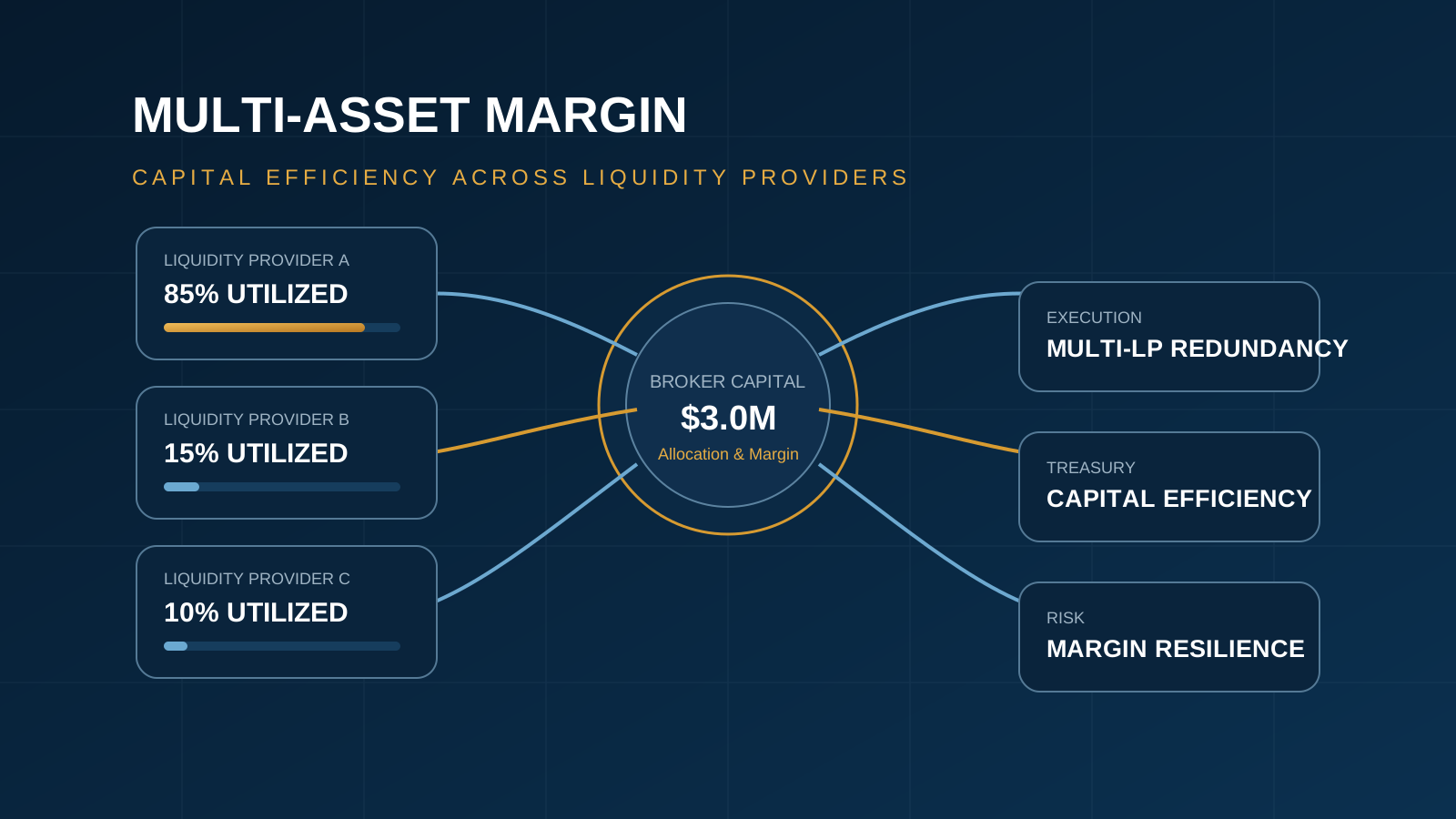
Executive Summary
Maintaining multi-LP redundancy is standard operational practice for modern forex and CFD brokerages. Operating with two, three, or more liquidity providers mitigates counterparty concentration risk, enables competitive spread aggregation, and guarantees failover routing during market volatility.
However, redundancy introduces a persistent balance sheet challenge: capital drag. Segmenting operational liquidity across multiple clearing accounts traps significant working capital, creates margin buffers that sit idle, and heightens the risk of localized stop-outs on one LP while capital sits unutilized on another.
For Chief Financial Officers (CFOs), Heads of Dealing Desks, and Operations Directors, managing multi-asset margin is no longer just a treasury reconciliation task. It is an operational discipline that directly dictates a brokerage's return on capital, execution quality, and risk resilience.
1. The Real Cost of Fragmented Collateral
When a brokerage connects to multiple liquidity providers—typically combining a primary Prime of Prime (PoP) with secondary non-bank market makers or specialized crypto venues—it must pre-fund margin accounts at each venue.
The Fragmented Liquidity Dilemma
Illustrative allocation from the articleConsider a brokerage allocating $3,000,000 across three venues ($1,000,000 each):
Idle Buffer Inefficiency: To prevent sudden market movements from triggering margin calls, risk desks keep substantial cash buffers in each account. In practice, 30% to 50% of this collateral sits idle, earning minimal or zero yield while incurring financing overhead.
Localized Margin Squeezes: Client order flow is rarely distributed evenly across LPs. A sudden surge in retail demand for gold (XAU/USD) or US equity indices may route heavily to LP A due to tighter pricing. LP A's margin utilization spikes toward 90%, triggering urgent top-up requirements, even though LP B and LP C hold ample unencumbered collateral.
Emergency Transfer Friction: Moving capital between clearing counterparties via SWIFT or international wire transfers takes hours or days. By the time emergency margin arrives, the bridge may have already choked off routing to the best-priced provider to protect account balance limits.
2. Structural Comparison: Single Margin vs. Multi-Account Allocation
The structural difference between single-account aggregation and multi-venue margin models defines how efficiently a brokerage deploys its reserves.
| Metric / Feature | Fragmented Multi-LP Accounts | Prime of Prime (PoP) Umbrella | Tri-Party Custody / Cross-Margin |
|---|---|---|---|
| Capital Utilization | Low (40%–55% active) | High (75%–85% active) | Optimized (80%–90% active) |
| Operational Overhead | High (Multiple daily reconciliations) | Low (Single daily statement) | Moderate (Custodial reporting) |
| Counterparty Risk | Distributed across multiple LPs | Concentrated in single PoP | Minimized (Held off-balance-sheet) |
| Cross-Asset Offsets | None (Siloed by venue) | Broad (Internal cross-netting) | Dependent on custodian terms |
| Transfer Latency | Hours to business days (Wires) | Instant (Internal ledger allocation) | Near-instant ledger movements |
3. The Cross-Asset Margin Multiplier
Modern brokerages offer hundreds of instruments: FX pairs, precious metals, energy CFDs, cash equity indices, and cryptocurrency derivatives. Each asset class operates under distinct volatility profiles, regulatory margin rules, and counterparty hair-cuts.
Cross-Asset Netting Dynamics
Portfolio offset illustrationCorrelationPortfolio netting
When multi-asset flow is routed across disparate providers without unified netting, the brokerage faces double capitalization:
Siloed Directional Offsets: If clients are aggregate net-long gold on LP A (requiring USD margin) and net-long USD/JPY on LP B, the macroeconomic exposure partially offsets at the firm level. However, because the positions live in disconnected clearing accounts, both providers demand full, unhedged margin requirements.
Non-Standard Margin Schedules: Digital asset and commodity CFDs often carry variable margin rates that scale aggressively during weekend sessions or ahead of high-impact macroeconomic events (e.g., US Non-Farm Payrolls, FOMC decisions). Failing to factor in asset-specific margin multipliers creates unexpected liquidity locks.
4. Operational Controls for Treasury & Dealing Desks
To extract maximum capital efficiency without elevating insolvency risk, operations teams must establish systemic controls across their bridging and treasury architecture.
Dynamic Bridge Margin Throttles
Auto-switch routing at 80% usage.
Automated Rebalancing Triggers
Internal instant ledger transfers.
Volatility Pre-Funding Protocols
Pre-event stress-tested buffers.
Non-Cash Collateral Facilities
Treasury bills and bank guarantees.
1. Dynamic Routing Limits in the Aggregation Engine
Modern bridge engines (such as oneZero, PrimeXM, or Centroid) allow dealing desks to set automated margin utilization thresholds.
When LP A reaches 80% margin consumption, the aggregation rule should automatically reweight incoming volume to LP B or LP C for select instruments. This eliminates execution rejections caused by margin exhaustion while allowing treasury teams time to execute transfers systematically.
2. Digital Asset and Fiat Hybrid Collateral Pools
For brokerages operating active crypto CFD or 24/7 weekend desks, standard banking rails are inadequate for weekend capital rebalancing.
Leading institutional operations deploy stablecoin reserves (e.g., institutional-grade USDT or USDC pools held in secure custody) linked directly to crypto liquidity venues. This enables treasury desks to execute margin top-ups in minutes on a Saturday afternoon, avoiding weekend clearing deadlocks.
3. Non-Cash Collateral and Tri-Party Custody
Larger brokerages should avoid holding 100% of collateral in uncollateralized operational cash deposits. Instead, negotiate collateral structures that accept:
- Government Paper: Short-term US Treasury bills or sovereign debt.
- Bank Guarantees (SBLCs): Standby Letters of Credit that allow the broker to post a fraction in cash while using a banking facility to satisfy margin obligations.
- Tri-Party Custody Accounts: Funds sit with an independent custodian bank, protecting the brokerage against provider insolvency while giving the LP legal security to extend trading lines.
5. Liquidity Provider Due Diligence: Assessing Margin Terms
When selecting and reviewing liquidity partners, margin mechanics should be scrutinized with the same rigor applied to spread profiles and latency metrics.
Five Critical Due Diligence Inquiries
What are your intraday versus weekend margin policies?
Does the provider increase margin requirements automatically on Friday afternoon? By how much, and what is the exact schedule for reversion on Monday?
What collateral haircuts are applied across non-base currencies?
If your master margin account is denominated in USD but you trade EUR or JPY pairs, what haircut is deducted on unrealized non-USD P&L?
What is the stop-out enforcement mechanism?
Does the provider initiate automated liquidations at 100% margin level, or is there a buffer window allowing operational desks to wire funds or close offsetting risk manually?
Is cross-margining supported across asset classes?
Can equity CFD profits directly offset commodity or currency CFD margin requirements within the same master account?
What are the technical and banking rails for emergency deposits?
Does the counterparty support fast-settlement rails, internal account transfers, or crypto rail deposits outside standard banking hours?
6. The Bottom Line: Moving from Idle Cash to Active Capital
In a competitive market where brokerage margins are compressed by tight client spreads and rising operational costs, capital efficiency is a primary lever for profitability.
Treating margin allocation as a static setup leads directly to capital drag, heightened operational stress, and execution bottlenecks. By implementing dynamic aggregation routing, negotiating cross-margining facilities, and establishing automated rebalancing protocols, brokerages can free up substantial balance sheet capacity.
The objective is clear
Maintain total redundancy and execution quality while ensuring every dollar of corporate capital serves an active, revenue-generating purpose.
Improving capital efficiency?
Refine the execution and treasury architecture behind your brokerage.
Spot Liquidity provides institutional guidance on liquidity bridge configuration, operational risk management, and capital optimization for brokerages and prop firms.
Book a ConsultationThis article is provided for general informational purposes only and does not constitute financial, legal, regulatory or tax advice. Margin structures, collateral arrangements and counterparty terms vary by provider, jurisdiction and business model. Independent professional advice should be obtained where appropriate.