
Executive Summary
For decades, the global financial architecture operated on rigid, synchronized schedules dictated by geographic time zones and central clearinghouses. In precious metals trading, the Friday market close was treated as an unalterable rule of the market. However, shifting market microstructures, the rise of digital asset markets, and accelerating macroeconomic volatility have rendered the traditional 48-hour weekend market closure an operational vulnerability.
Continuous 24/7 gold trading (XAU/USD) represents a fundamental modernization of wholesale liquidity infrastructure. By bridging the weekend gap, top-tier institutional liquidity providers are offering brokerages a dual-advantage mechanism: an active risk management tool to neutralize off-hours market exposure, and an engine for continuous trading volume.
This comprehensive analysis examines the mechanics of synthetic and OTC weekend pricing, operational integration protocols, risk mitigation strategies for dealing desks, and the commercial rationale for retail and institutional brokerages.
1. The Evolution of Precious Metals: Breaking the 5-Day Barrier
Gold has served as humanity’s primary store of value and premier safe-haven asset for thousands of years. In modern electronic markets, XAU/USD consistently ranks as one of the most traded CFD instruments globally, commanding trillions of dollars in annual turnover across spot, futures, and derivative venues.
| Traditional Cycle | Modern 24/7 Model |
|---|---|
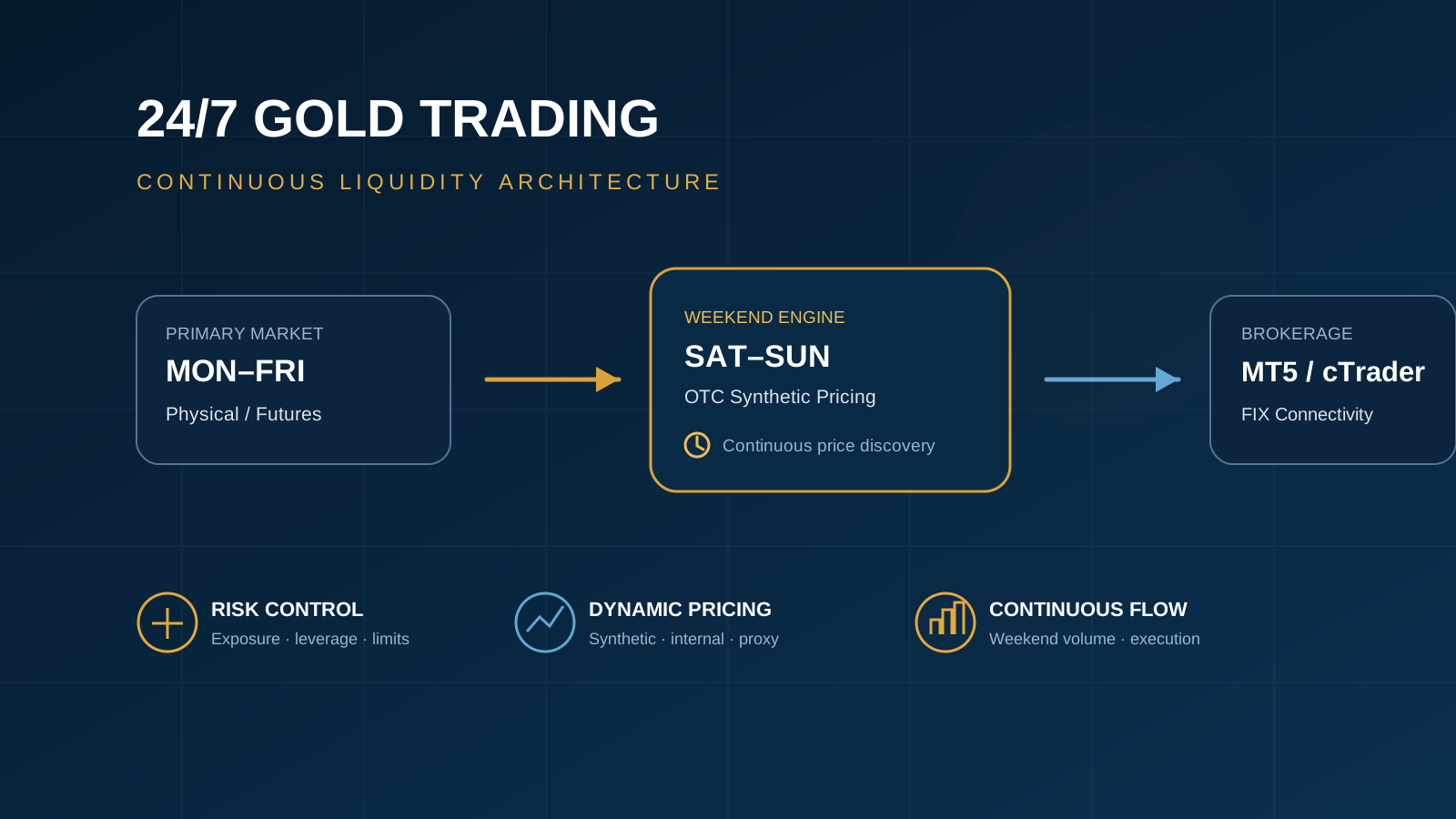
| [ Mon - Fri: Active Trading ] → [ Sat - Sun: Market Darkness (High Gap Risk) ] | [ Mon - Fri: Primary Physical/Futures ] → [ Sat - Sun: OTC Synthetic Matching Engine ] |
The Institutional Rhythm and Its Historical Constraints
Traditional gold pricing is anchored to two primary pillars:
- The London Bullion Market Association (LBMA): Setting the global benchmark through its twice-daily physical auctions.
- The Chicago Mercantile Exchange (CME/COMEX): Providing deep liquidity through standardized futures contracts (GC).
When these underlying exchanges went dark on Friday evening, retail and institutional platforms froze order books until Sunday afternoon.
The Catalyst for Change: The 24/7 Trading Culture
The rise of decentralized finance and cryptocurrency markets proved that retail and institutional capital would actively trade on weekends if an accessible market existed. As gold increasingly reacts to sudden weekend geopolitical shifts, continuous access to XAU/USD has transitioned from an experimental feature to a core market requirement.
2. Anatomy of the Weekend Gap: The True Cost of Inaction
The primary catalyst driving institutional interest in 24/7 gold trading is the elimination of weekend gap risk.
| Risk Category | Impact Without 24/7 Liquidity | Resolution via 24/7 Liquidity |
|---|---|---|
| Negative Balance Liability | Weekend gaps jump over retail stop-loss orders, plunging accounts into deep negative equity that the broker must legally absorb. | Continuous execution allows stop-loss and margin calls to trigger progressively as news breaks, preserving capital. |
| B-Book Asymmetric Risk | Unhedged weekend positions held on the broker's internal book can result in catastrophic portfolio drawdowns. | Internal dealing desks can dynamically manage exposure, hedge client flow, or adjust books in real time. |
| Client Dispute Volume | High slippage on Sunday night market re-opens drives customer complaints and regulatory churn. | Smooth, continuous price discovery provides clear transaction history and predictable execution. |
3. Technical Architecture: How Weekend Pricing Works
A primary concern for institutional risk officers and CTOs is the technical mechanics of price discovery when traditional clearinghouses are offline.
Weekend OTC Price Discovery Flow
[ Algorithmic Engines ] | [ Internal Liquidity ] | [ Cross-Asset Proxies ]
Volatility Modeling | Dark Pools | Crypto Gold Tokens
Historical Drift Mapping | Institutional Flow | Sentiment Mapping
↓
[ Ultra-Low Latency Smart Aggregator ]
Dynamic Spread Calibration • Risk Parameter Enforcers
↓
[ FIX API 4.4 / MT5 / cTrader Gateway ]
1. Multi-Factor Synthetic Pricing Engines
Without active exchange order books, tier-1 liquidity providers deploy mathematical modeling to establish real-time fair market value, tracking digital representations of physical gold (such as PAXG or XAUT) and correlated weekend digital currency pairs.
2. Global Institutional Crossing Networks
During the weekend window, the provider’s internal matching engine functions as an institutional dark pool, pairing buyers and sellers internally.
3. Dynamic Spread Calibration
Because weekend market depth is structurally thinner, continuous pricing utilizes dynamic spread adjustments. These wider spreads act as a natural risk management buffer.
4. Operational and Technical Integration Protocols
Deploying 24/7 gold trading does not require brokerages to rebuild their existing technological infrastructure.
- FIX Protocol Connectivity: Standard institutional feeds run continuous streams via FIX 4.4 / 5.0 without Friday session resets. Connectivity is hosted in Tier-3/Tier-4 financial data centers (LD4, NY4, TY3).
- Trading Platform Implementation: Brokerages either configure a unified XAUUSD symbol running 00:00 - 24:00 daily, or separate exposure by introducing a dedicated weekend contract (XAUUSD.w) with distinct margin parameters.
5. Commercial Rationale: Turning Inactive Hours into Revenue
The introduction of 24/7 gold liquidity represents an operational and commercial upgrade. Historically, Saturday and Sunday generated zero trading volume while fixed infrastructure costs continued to accrue.
Continuous gold trading recaptures this capital. In a saturated retail forex/CFD space, offering 24/7 gold trading provides a clear marketing differentiator, lowering blended customer acquisition costs and attracting momentum traders.
6. Risk Management Framework for Brokerage Dealing Desks
While 24/7 trading unlocks commercial opportunities, dealing desks must implement rigorous risk parameters tailored for off-market hours.
Dealing Desk Risk Controls for Weekend Trading
- Dynamic Leverage Scaling: Automatically throttle peak leverage configurations (e.g., scaling down from 100:1 to 20:1) over the weekend.
- Maximum Ticket Caps: Enforce strict ceilings on maximum single-order notional values to prevent internal liquidity pool exhaustion.
- Automated Gap Absorbers: Reject execution requests that fall outside algorithmically approved volatility bands.
- Cross-Asset Hedging: Allow dealing desks to utilize tokenized gold to offset net directional delta.
7. The Regional Epicenter: Why Dubai and the MENA Region Lead
The shift toward continuous gold liquidity is gaining its strongest momentum across the Middle East. The region has a deep economic affinity for precious metals and a commercial structure built around Sunday working hours. With forward-thinking regulatory oversight from the DFSA and SCA, Dubai serves as the natural capital for the rollout of continuous institutional liquidity.
8. Institutional Due Diligence Checklist: Selecting a Liquidity Partner
When evaluating an institutional liquidity provider for continuous 24/7 gold trading, brokerage leadership and risk committees should assess:
- Pricing Methodology Transparency: Synthetics vs. Proxies vs. Internal matching.
- Latency & Bridge Resilience: Sub-millisecond FIX routing capabilities.
- Weekend Spread Stability: Consistency during low-volatility hours.
- Settlement Protocols: Seamless integration with weekday clearing cycles.
- Regulatory Standing: Compliance with Tier-1 institutional oversight.
The Strategic Road Ahead
The introduction of 24/7 gold trading represents the first major milestone in the CFD industry's transition toward a continuously active market. Brokerages that modernize their liquidity bridges and risk management engines today will capture market share, build loyal trading communities, and insulate their balance sheets from structural weekend gap risks.
Exploring continuous liquidity?
Build the operational framework around the product.
Spot Liquidity supports brokerages across liquidity connectivity, bridge configuration, platform administration and risk-management operations.
Book a ConsultationThis article is provided for general informational purposes only and does not constitute financial, legal, regulatory or tax advice. Product structures, liquidity arrangements and regulatory requirements vary by jurisdiction and business model. Independent professional advice should be obtained where appropriate.